1289. Minimum Falling Path Sum II
Given an n x n integer matrix grid, return the minimum sum of a falling path with non-zero shifts.
A falling path with non-zero shifts is a choice of exactly one element from each row of grid such that no two elements chosen in adjacent rows are in the same column.
Example 1:
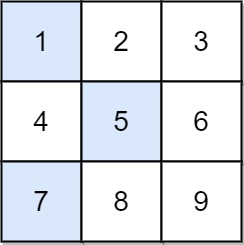
Input: grid = [[1,2,3],[4,5,6],[7,8,9]]
Output: 13
Explanation:
The possible falling paths are:
[1,5,9], [1,5,7], [1,6,7], [1,6,8],
[2,4,8], [2,4,9], [2,6,7], [2,6,8],
[3,4,8], [3,4,9], [3,5,7], [3,5,9]
The falling path with the smallest sum is [1,5,7], so the answer is 13.
Example 2:
Input: grid = [[7]]
Output: 7
Constraints:
n == grid.length == grid[i].length1 <= n <= 200-99 <= grid[i][j] <= 99
ANSWER:
class Solution {
public int minFallingPathSum(int[][] grid) {
int firstMin = 0;
int secondMin = 0;
int firstMinPos = -1;
final int INF = Integer.MAX_VALUE;
for (int[] row : grid) {
int curFirstMin = INF;
int curSecondMin = INF;
int curFirstMinPos = -1;
for (int j = 0; j < row.length; ++j) {
int sum = (j != firstMinPos ? firstMin : secondMin) + row[j];
if (sum < curFirstMin) {
curSecondMin = curFirstMin;
curFirstMin = sum;
curFirstMinPos = j;
} else if (sum < curSecondMin) {
curSecondMin = sum;
}
}
firstMin = curFirstMin;
secondMin = curSecondMin;
firstMinPos = curFirstMinPos;
}
return firstMin;
}
}
Comments
Post a Comment